By Noor Saleem, program evaluator; Ilona Fricker, clinical advisor for physiotherapy; and Dr. Justin Hett, clinical advisor for mental health
Back in 2011 as the Syrian war started forcing millions to flee their homes, CVT began extending interdisciplinary mental health, physiotherapy and social work services to Syrians arriving in Jordan. An additional critical component of this care is CVT’s monitoring and evaluation practices used to ensure care is effective and accessible. Thousands were able to begin rebuilding their lives even while they remained displaced, and CVT’s evaluation team captured key data on what worked best to help people heal.
Many torture survivors had been unable to access in-person services previously because of a wide range of barriers: limited relevant languages, cost, transportation, stigma, concerns around trust and confidentiality, and as always, the broader instability associated with displacement.
Thousands were able to begin rebuilding their lives even while they remained displaced, and CVT’s evaluation team captured key data on what worked best to help people heal.”
In response, in 2021 CVT launched Arabic tele-mental health (TMH) services for displaced Syrians. Starting with clients living in Türkiye, the team’s efforts to increase access to remote support has since evolved into a broader telehealth model reaching survivors across the Middle East and North Africa (MENA). Our focus on best practices in monitoring and evaluation helped the team as opportunities to provide care increased and we had solid understanding of the scalability of remote service delivery.
The current initiative includes both TMH and tele-physiotherapy (TPT). Services are now implemented through programs including CVT’s Survivors of Torture Initiative (SOTI), which supports Syrian civil society with a focus on detainees, torture survivors and their families. As a component of this work, CVT partners with the Association of Detainees and the Missing in Sednaya Prison (ADMSP) to extend the reach of telehealth services, especially inside Syria.
Today, the telehealth model serves a diverse range of populations, including survivors of torture, former detainees, human rights defenders, activists and families of forcibly disappeared individuals. Here are a few quotes shared by clients about their experiences with the service:
“The sessions helped me adapt to the new society by receiving support from someone who has knowledge of the Syrian context…something I lacked with non-Arabic speaking specialists.” -Survivor client
“The sessions have greatly increased my awareness about the impact my work has on me. There are numerous difficulties and challenges and self-care is often neglected. I now consider this a priority rather than a selfish behavior.” – Human rights defender client
“During the sessions and after practicing the exercises, I felt as if a screaming voice inside me had stopped.” -Survivor client
Building an Evaluation Framework Alongside Service Delivery
CVT recognized early on the importance of integrating monitoring, evaluation, accountability and learning into the telehealth model. In late 2025 and early 2026, we conducted a comprehensive evaluation of telehealth services to assess both the effectiveness of the interventions and the readiness of the model for future scale-up within the MENA region and beyond.
CVT recognized early on the importance of integrating monitoring, evaluation, accountability and learning into the telehealth model.”
The evaluation aimed to identify opportunities to strengthen quality, accessibility, equity and scalability. Tele-mental health was assessed as a specific intervention (a 3-5 session, structured, remote psychosocial intervention model), while tele-physiotherapy was evaluated as the standard CVT physiotherapy approach, adapted from an in-person format intended for remote care.
Effectiveness findings were largely encouraging, suggesting that the telehealth model, both TMH and TPT, is generally responsive to client needs, seems to produce meaningful improvements within a brief intervention framework, and offers an important access point for individuals who may otherwise be unable to engage in care. However, the evaluation identified opportunities to further refine telehealth and strengthen related monitoring and evaluation frameworks. These recommendations focus on strengthening both services and better positioning them for scale-up and expansion within and/or beyond CVT. This iterative process of data collection, associated learning and refining the intervention approach is part of the broader ecosystem of results-based management at CVT.
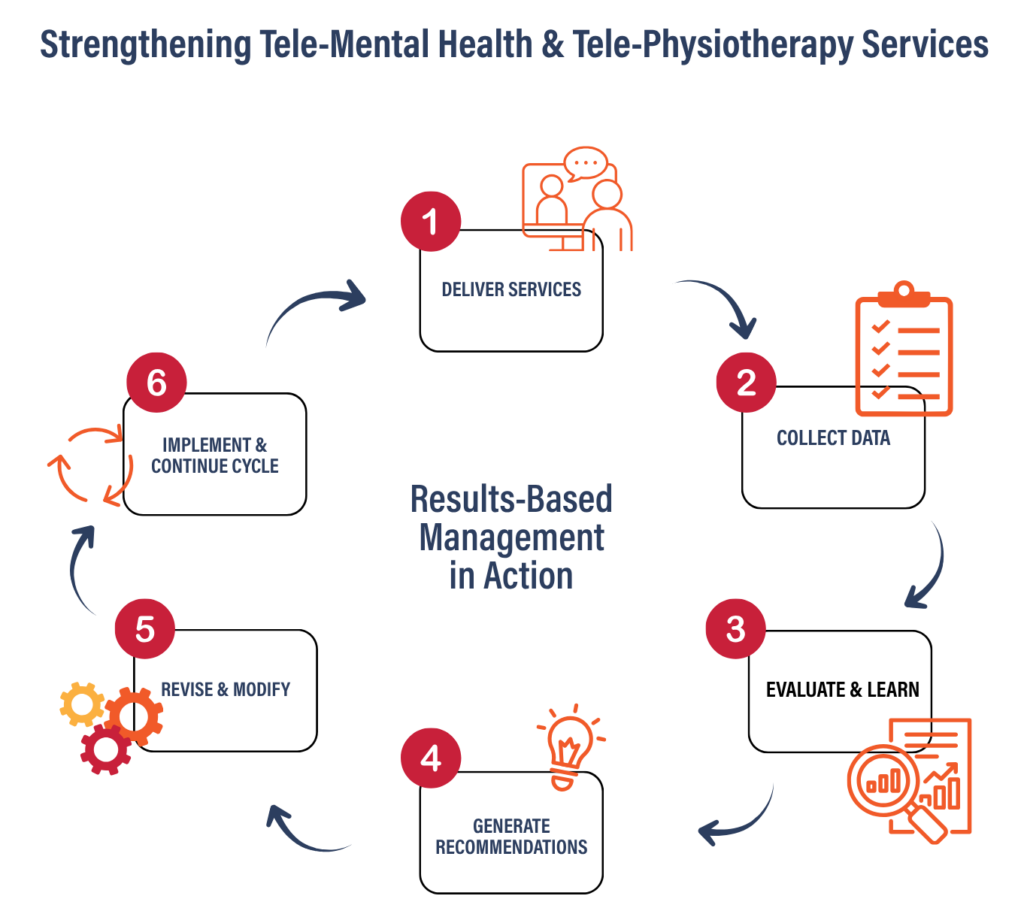

As shown in the graphic, collecting data on outcomes and client experiences is key to assessing effectiveness. Using a model like this, a clinical team develops practical, evidence-based recommendations and continuously reviews findings and adjusts services. This allows teams to incorporate improvements on an ongoing basis.
Looking Ahead
The evaluation process has already begun shaping the next phase of telehealth implementation at CVT. Several strategic priorities are currently moving forward, including:
- Development of a contemporary theory of change, including a dedicated TMH theory of change and refinement of intended outcomes within the TPT framework.
- Review and refinement of referral pathways, outreach approaches, and inclusion/exclusion procedures.
- Increased interdisciplinary coordination between TMH and TPT teams to strengthen continuity and integration of care.
- Ongoing refinement of intervention frameworks, protocols and training manuals.
- Strengthening pre- and post-intervention data collection systems to better align assessments with intended outcomes and validated measures.
- Establishment of a working group focused on learning, reflection and adaptive implementation.
- Development of data-informed learning products for internal and external stakeholders.
The evaluation also reinforced the importance of remaining responsive to the evolving realities facing survivors, activists and vulnerable communities throughout the region.
As telehealth services continue to expand globally, ensuring that services remain accessible, evidence-informed, ethically grounded and responsive to participant needs will remain essential.
This example serves as a model for how clinical services and evaluation and research teams collaborate at CVT to design effective interventions and remain accountable to survivors, donors, partners and other stakeholders. Ilona Fricker, clinical advisor for physiotherapy, said, “The evaluation was a critical learning opportunity, confirming the meaningful impact of telehealth and guiding us toward further improvements in both clinical delivery and staff training.”