Shown in photo: CTRT graduates and supervisors
By Frezgi Gebrekristos, psychotherapist/trainer, and Kiflom Negash, associate physiotherapist/trainer, both with CVT Ethiopia.
If you had walked into the assembly hall in Shire on the morning of June 22, the first thing you’d notice would be the colorful ribbons and large number of guests invited to celebrate a big event. But what actually took your breath away was the confidence in the eyes and the smiles in the faces of the 16 graduates sitting at the middle of this unforgettable ceremonial event.
Six months ago, when these 16 volunteer trainees from Shire and Endabaguna first joined the Resilience, Empowerment, and Support for Trauma-Oriented Recovery and Engagement (RESTORE) project funded by the German Federal Ministry for Economic Cooperation and Development (GIZ) and implemented by CVT, many of them quietly doubted themselves. How could they possibly help their communities heal from the deep, hidden wounds of the Tigray war? But during the graduation ceremony, as they stood up to demonstrate a role-play, that hesitation was completely gone. They spoke about trauma responses, grounding techniques, and when to refer someone to the further care of practitioners, with a fluency that surprised even our own clinical team. Sitting in the audience, watching them, you could physically feel the shift.
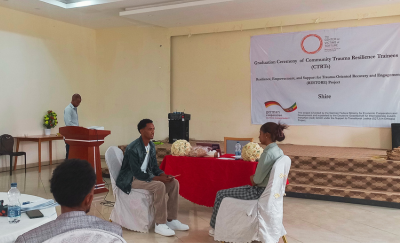

Photo: CTRT graduates demonstrating role play as a helper and client.
During these months, the Community Trauma Resilience Trainees (CTRTs) followed a carefully sequenced curriculum designed and delivered by CVT experts in trauma intervention. The training progressed from foundational knowledge of how trauma impacts the brain, body and social fabric into applied skills: psychological first aid, grounding techniques, basic counseling skills and trauma-informed care linking bodily tension to emotional experience.
Importantly, the program was backed by continuous supervision and mentoring from senior CVT counseling and physiotherapy supervisors and trainers. This was not a periodic check-in, but the backbone of the structured training. Supervisors observed sessions, reviewed case discussions, debriefed difficult moments and helped trainees process their own emotional responses, which is a vital safeguard against the secondary trauma often experienced by frontline helpers, as is the retraumatization that could affect wounded healers. This ongoing support is what separates a one-off workshop from a true capacity-building pathway.
The curriculum aligned with the Inter-Agency Standing Committee (IASC) mental health and psychosocial support (MHPSS) pyramid on the global framework organizing psychosocial support into complementary layers, from basic security to specialized clinical care. By graduation, trainees were equipped to work confidently across the lower and middle layers of the pyramid, with the critical ability to identify when a case required referral to higher-level, specialized care.
From Trainees to Facilitators: Intertwining Resilience into Local Systems
During the graduation ceremony, senior representatives from the Social Affairs, Education, and Health Bureaus, alongside a GIZ representative, were in attendance. Their presence reflected a core design choice of the RESTORE project: trauma resilience cannot be sustained by a single NGO operating in isolation. It must be intertwined into the local systems which communities already trust, and which support and can contribute towards sustainable peace.
A key achievement in the graduation ceremony was the CTRT’s proposal development entitled “From Vulnerability to Resilience.” The community-driven proposal was drafted by the trainees and focuses on addressing the root causes and psychosocial consequences of illegal immigration and substance abuse among young people and vulnerable community members, through awareness raising, prevention, community engagement and resilience-building interventions. This initiative demonstrates the graduates’ commitment to translating knowledge into action and reflects the broader objectives of building resilient communities that are better equipped to cope with challenges and recover from adversity.
Photo: CTRTs presenting their proposal in the graduation ceremony.
What stayed with everyone on June 22 was the visible transformation of the trainees themselves. Many had entered the program unsure if they had the right to call themselves trauma facilitators. The practical engagement deepened their understanding of trauma, allowing them to learn new strategies and provide basic services to the affected community. The training curriculum deliberately exposed them to broader case-management process, ensuring they know exactly who to call and how to safely hand over complex cases.
This project is designed to be implemented in three cohorts of 60 facilitators in the Shire and Endabaguna locations. Training the first cohort across both locations was a strategic choice which built a resilient network of facilitators who can share caseloads and cover for one another. A lone facilitator in a remote community is vulnerable; a network across two towns is durable. This network is already growing, with a second cohort currently in training and visibly inspired by the June 22 graduates.
Voices from the Ceremony
Some of the most powerful moments came when graduates, new trainees, and guests spoke. Their words captured the project’s meaning more plainly than any report could:
Before joining this training program, I felt like I had lost myself in everything we went through. This training didn’t just teach me how to help others; it gave me back my identity.”
-Trainee from Shire
I always had the heart to help; I wanted to help my neighbors but felt powerless. But this training transformed my capability. Now, I actually have the skills to care for the people who need me.”
-Trainee from Endabaguna
This journey has been beyond an academic diploma or degree.”
-Trainee from Endabaguna
You are no longer trainees simply taking on a legacy. Today, you become the legacy. You are the ones who will carry this community support forward long after this project ends.”
-GIZ representative
What Changes Now?
With the graduation complete, the project enters its most impactful phase. The newly certified facilitators will begin community-based outreach activities in their respective neighborhoods, schools, health centers or posts and women’s groups, reaching people who would never walk into a formal mental health clinic. Their presence changes in three concrete ways:
- Identification: Embedded in everyday spaces, facilitators can spot the early signs of trauma and offer a first basic MHPSS to the affected community.
- Response: They can deliver structured psychosocial support, including grounding techniques, psychoeducation and peer-group sessions. For many community members, this is considered to be enough to meaningfully reduce distress and restore function.
- Referral: When a case exceeds a paraprofessional’s scope, facilitators now know exactly how to refer onward to CVT and other available specialized clinical services or psychiatric care. The RESTORE project has spent six months building these relationships, creating a functional system rather than a set of isolated workers.
The Way Forward
Photo: Graduation ceremony with invited participants.
A graduation is just the starting line. On June 22, we didn’t close a program; we activated a community. Our newly certified facilitators are now stepping into their roles across Shire and Endabaguna to meet the urgent mental health needs of their neighbors. With the Social Affairs Bureau already committing to long-term, local ownership of these efforts, the foundation for lasting change is firmly set. For CVT, GIZ and government stakeholders, the mandate is clear: protect and mentor this capacity.
The ribbons from graduation day will fade, but the healing they sparked will not.